The problem is that there are so many different options out there, and it can be easy to agree to a higher interest rate without realizing that you could qualify for a lower interest rate if you looked elsewhere. The fact of the matter is, whether you choose to go with a bank, credit union or even online lenders, you want to get a low-interest loan that offers the lowest interest rate possible.
Personal Loan Interest Rates
Interest rates for personal loans in Canada often fluctuate with the Bank of Canada’s current prime rate. Since the federal government is trying to curb inflation, the interest rates are a bit higher than what we are normally used to seeing. When it comes to getting a personal loan, you are looking at a rate of anywhere from around 8% to 45%. A few factors determine this rate. These include your credit score and your debt-to-income ratio.
It is most common for banks and credit unions to have the lowest interest rates, but private lenders are stepping up to the plate. Just like any business, their primary goal is to make money; if they give you a loan, they are making money on the interest. Believe it or not, there are more Canadians than you think who have a credit score of at least 700. Because private lenders are now expanding into lower-interest-rate loans, there is not only more opportunity for them to make money but also more choices for consumers to find a lender that works for them. They’re a great option for wedding loans in Canada, home improvement loans and more.
The Big Banks and Personal Loans
When looking for an unsecured loan, the Big 5 banks are usually a first choice. This is because they tend to be comfortable and reliable. They also have interest rates that seem very reasonable. This, however, doesn’t mean that they offer the best personal loans. Often, the larger the bank, the more products you have with them, the lower your interest rate will be.
Sometimes, lenders require you to purchase insurance on your loan; otherwise, you will be charged a higher interest rate. This can happen whether you have a low credit score or an excellent credit score and can add a substantial amount to your loan, depending on how much you are borrowing. You also need to consider how long it will take to get a loan. With most banks, you are looking at about a week before you have access to any funds.
TD
Right now, if you are looking for an unsecured loan with TD, it is advertised at prime plus 2.99,% with prime sitting at 5.45% when it was announced. This was advertised in November of 202,2 and prime has gone up since then. This makes it likely that a personal loan is now upwards of the 8.44% that was advertised.
While this amount might not seem that high, it is important to keep in mind that it applies only if you meet the debt-to-income ratio and credit qualifications. Most large banks require a minimum credit score of 640 to 680 to be approved for a rate like this, but a score of 700 is ideal. If you don’t meet these qualifications, then the rates will likely be lower.
RBC
With RBC, there are no advertised rates. They advertise that you will get a personalized rate based on your current income and debt situation. This means you won’t know what the minimum interest is or even have an idea of the interest rate before you apply.
They advertise a skip-payment option, and you can choose your loan term to be as short as 1 year or as long as 5 years. They also advertise fixed or variable rates. That being said, the requirements to get a personal loan with RBC are much stricter than other big banks, so it can be much more difficult to qualify for their best interest rate.
Scotiabank
As of December 8, 2022, Scotiabank’s advertised Prime Rate is 6.450%. With that in mind, the rate you will end up with for a personal loan will depend on what you are approved for based on your individual financial situation.
CIBCLike
Just like some other larger banks, CIBC doesn’t list personal loan rates on its website. You don’t have any indication of an interest rate until after you’ve filled out an application.
That said, CIBC has a personal loan minimum of $3,000, which is quite high. Many people seeking a personal loan are looking for only $ 500 to $2,000. Their personal loans do go up to $200,00,,0 but there would be plenty of restrictions that come with that much money.
BMO
Personal loan rates with BMO also aren’t advertised on their website. After you apply, you will receive an offer. This makes it really difficult to know whether you would be approved for a lower interest rate elsewhere. They would also have to do a hard credit check, which can hurt your credit score if you get too many. You shouldn’t have more than 6 in a calendar year.
Low Interest Rate Loans and Private Lenders
Many people think that private and alternative lenders are only for bad-credit personal loans. While that is technically true, they also do offer loans for those with good credit. Many private lenders are now offering loans at interest rates that rival those of the big banks. Let’s take a look at one example.
Spring Financial
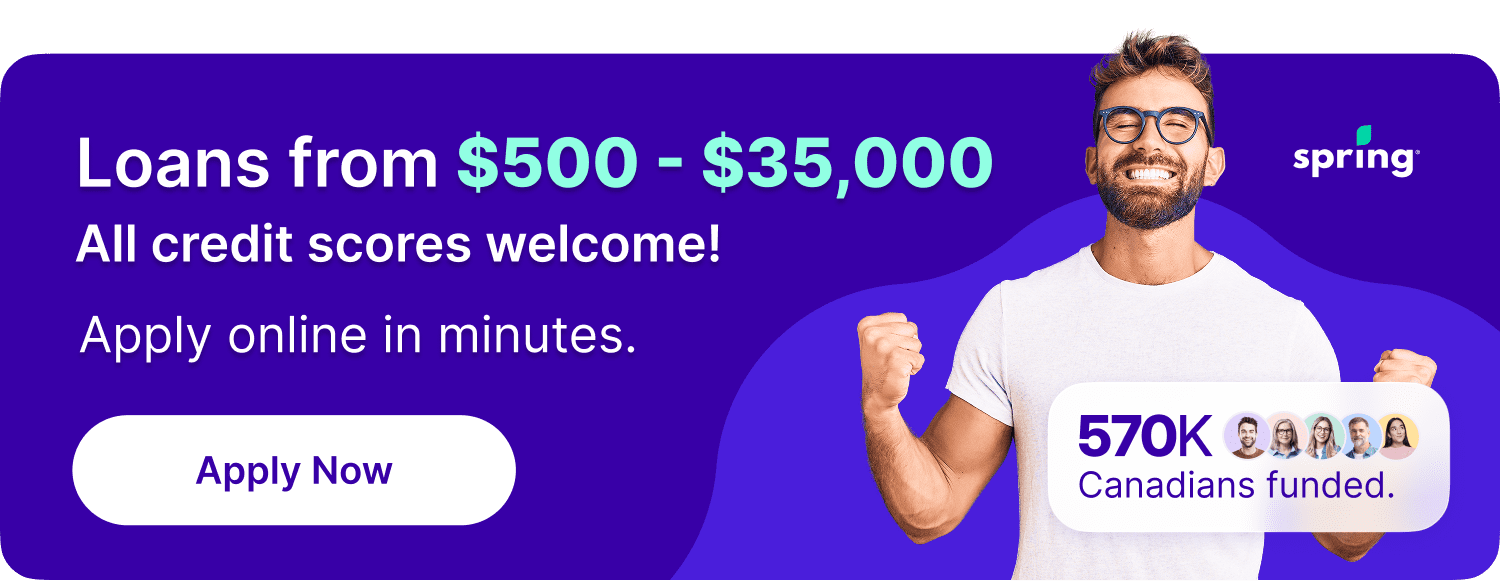
At Spring Financial, you can get a personal loan ranging from $500 to $35,000 for as low as 9.99% APR. Not only that, there are no penalties for paying off the loan early. Unlike traditional lenders, Spring allows you to complete the process online, over the phone, or through text message. In most cases, you can receive the funds the same day you get approval.
While you are still required to have a decent credit score and credit history, they tend to be much more lenient than most larger financial institutions. The convenience alone is much nicer than going to a branch or waiting a week for funds you likely need right away.
The Spring website includes a personal loan calculator. This will help to determine what your payments and interest rate will look like based on a few factors. While this isn’t an accurate determination of your monthly payment and isn’t a valid rate, it will show you what your payments would look like in all possible scenarios.
Low Interest Rates and Bad Credit
While getting a personal loan with bad credit isn’t always as difficult as you may think, you are likely to have a much higher interest rate if you don’t have a decent credit score. While some personal loan lenders will allow you to have a lower interest rate with a minimum credit score of around 620, anything under 600 will end up having a much higher interest rate.
Personal loan providers will lend to those with bad credit, but at a higher interest rate. While this isn’t always ideal, it’s much better than a payday loan, which isn’t increasing your credit score at all. Payday loans also have higher interest rates. With an unsecured personal loan, you can improve your credit score whenever you make a timely payment. By increasing your credit score, you can qualify for a loan with a lower interest rate in the future.
While this may not seem like much, unsecured personal loans are considered one of the most powerful forms of credit building. This is because there is no collateral attached to the loan, and the lender is essentially betting on you to pay the funds back.
Average Interest Rate on a Personal Loan
According to the Bank of Canada, the average interest rate on a personal loan in Canada is 8.45%. It is important to remember that this number is misleading because it includes both secured and unsecured loans. Secured loans often have significantly lower interest rates than unsecured loans.
With all that said, 8.45% is still pretty high for the average loan, especially since we are used to much lower interest rates. While it is still unpredictable what could happen to our interest rates, it isn’t likely they will drop anytime soon.
How To Qualify for a Low-Interest Loan
Whether you are applying through a bank, credit union or a private lender, the requirements to get approved for a low-interest rate loan stay virtually the same. While the exact specifications may be different, the general premise is the same. To even be considered by any lender, you have to be of the age of majority (18 or 19, depending on your province) and be a Canadian citizen or permanent resident. From there, the lender will go over the other requirements.
- A good credit score. While it is recommended to have a credit score of at least 680 to get a low interest rate, you may still qualify with a 620. However, the lender will consider more than just your credit score. What is on your credit report will also make a big difference.
- Low debt-to-income ratio. To get a low interest rate, lenders prefer a debt-to-income ratio below 40%. This means that 40% or less of your monthly income goes towards your monthly payments. These include mortgage payments and minimum debt payments. Rent payments are calculated separately.
- Stable source of income. While it is not necessary to be employed to get a personal loan, you do have to show that you have a stable source of income. Lenders like to see around 3 months of stable income. If you have just started a new job, it usually doesn’t make a difference if you were working steadily up until you started the new position.
- Net worth. Lenders will often look at your total net worth to help them decide what you can reasonably afford. This is often why people who own their own homes can borrow more than those who don’t.
- Low number of credit checks. Any time you do a hard credit check, it can deduct 5 to 15 points from your credit score. If you are looking for a loan and a lender notices many credit checks on your report, it can be seen as a red flag. To them, this says you either have a lot of debt or other lenders are not willing to take a chance on you.
- Total monthly or yearly income. Most lenders, on top of requiring a steady income, also require you to meet a monthly income minimum. This usually ranges from $1,200 to $1,500 per month. Many lenders will automatically decline you if you fall under this minimum, even if you meet all of the other requirements.
Easiest Bank to Get a Personal Loan
Getting a personal loan isn’t as difficult a process as it may seem, but it isn’t as simple as opening a bank account either. That’s why it can be much more difficult at a major bank. They often only give personal loans to those with high credit scores. Credit unions can be a little more lenient, especially if you have been a long-time customer of theirs or have a few other financial products.
If you are looking for debt consolidation loans and all of your loans are with the same bank or credit union, there usually isn’t an issue with approval, since they are just transferring your own funds into a better rate. That being said, that doesn’t mean you won’t get approved and get a better rate elsdoesn’t
If you haven’t taken out many loans, don’t have a good relationship with a major financial institution, or are just looking for a banking alternative that still offers low-interest personal loans, a private lender like Spring may be the best choice. As we briefly mentioned, a private lender is often more lenient than a large bank and can be a bit more flexible. Not only that, you can receive your money much faster. Since it is still considered a financial product, most private lenders report to the credit bureaus, allowing you to build your credit score while still getting the funds you are looking for. Even though in any of these situations you may not get the interest rate you were hoping for, you are setting yourself up to get a better rate the next time you need to borrow funds.
Documents Required for a Personal Loan
When applying for a personal loan, lenders will ask for documentation to prove that you can afford the loan, as well as meet their qualifications. These documents also help them determine the interest rate you would qualify for, if you qualify.
The first thing they would ask for is proof of employment. So this would be pay stubs or a letter of employment. A letter of employment is unusual if you have just started a new position, or if your pay stub doesn’t contain all of the information the lender needs. A likely cause of this is the company’s name not being on the pay stub.
The next thing they will ask for is a piece of government-issued ID. Most personal loan providers will not taaccept health cards, yoyyou willeed eia driver’sicense, a passport, or a provincial ID card.
After your employment and ID have been verified, most lenders will also require 90 days of bank statements. This shows what goes in and out of your account every month, proving you can afford the loan payments. If you are applying with an online lender, they have a verification tool that will provide this information, along with a direct deposit slip, just by signing in to your online banking. Do not worry; this technology is completely secure. If you are not using this tool, then you will need to provide a direct deposit form along with the bank statements. This form allows the lender to take out your personal loan payments on the agreed-upon dates.
Another thing they will require, if the address on your ID isn’t the same as your permanent address, is proof-of-address documents. Some lenders may require this either way. This is usually something like a credit card bill or a utility bill. It can even be a rental agreement if it is current within 6 months or so.
Personal Loans and Extra Fees
There aren’t many extra fees that can get tacked onto a personal loan, but the most common to watch out for is loan insurance. This insurance will cover your loan payments if you cannot make them due to job loss, critical illness, aaccident, r even death. For many lenders, this is an optional payment. Other lenders may offer a lower interest rate if you accept the insurance. While this insurance can be beneficial, if you already have life insurance or a similar policy, you may not need it. Insurance like this can cost thousands, so keep that in mind when you sign up for your loan.
Another fee you may notice on most personal loans is an application or documentation fee. Not all lenders charge this fee, but if they do, it will be on your loan paperwork. While this is usually only between $50 and $75, it is still something you have to consider.
Don’t forget that there are also late fees associated with missing a payment. Lenders will sometimes charge a late fee of 3-5%. On top of that, your bank will normally charge a late fee of around $ 5.00. These can usually be avoided by calling the lender beforehand and letting them know you are unable to make a payment. They are usually very flexible and can defer your payment or waive any late fees.
Is There Such Thing as an Interest-Free Loan?
No, personal loans don’t come interest-free. If that is the route you don’t intend to take, then you will pay some interest. That being said, there are credit cards that offer interest-free periods, usually up to 20 years. These are most often seen with furniture and appliance companies. If you intend to repay the funds quickly and are using the money for an item that qualifies for this option, it may be a good alternative to a personal loan. Keep in mind that once the interest-free period on these cards expires, the rate is much higher than that of a regular credit card, so it is important to pay this off on time if you choose to do this.
Types of Personal Loans
Whether you have a strong credit score or not, there are two different types of personal loans: unsecured and secured. Each works a little differently.
Unsecured Personal Loans
Unsecured personal loans are often also referred to as installment loans and cash loans. These loans tend to have higher interest rates since there is no collateral involved, but the loan balance can often be paid off early in one lump sum with no prepayment penalty.
With most unsecured loans, your monthly payments are reported to the credit bureaus. So, as long as you have no late or missed payments, your credit score will increase. Depending on the lender, there are two types of interest for these loans: variable-rate and fixed-rate.
Secured Personal Loans
Secured loans differ from unsecured loans because they require collateral. If you default on the loan, the lender can seize your assets to recoup its costs. Popular types of secured loans include:
- Home equity loans
- Home equity lines of credit
- Auto loans
Reasons To Get A Personal Loan
In Canada, many people have different reasons for taking out a personal loan. One of the most common is to consolidate debt. Consolidating debt means that you’re combining all of your debt payments into one monthly payment.
While you still pay interest on your debt with a consolidation loan, you save money by only making one monthly payment. While these types of loans can be easier to get with a high credit score, it’s still possible to do so with a low credit score.
A Personal Loan with Spring Financial
Applying for a loan with Spring is easy. You can apply directly online and receive approval quickly. Once you have approval and accept the offer, you can receive your funds. you prefer direct deposit, we can get you the money in 1 to 2 business days. Whether you are looking for a debt consolidation loan, need to pay some bills, want to make a large purchase, or just need some extra cash, there are no limits on what you can use your personal loan for. So, if you need money, are looking for a great interest rate and annual percentage rate, and don’t want to wait to receive your funds, apply today.